
 $ USD
$ USD
Blog
The Complete Guide to Skid Steer Attachments: Maximizing Efficiency, Power, and Return on Investment
A comprehensive guide to skid steer attachments, covering selection, performance optimization, and how to avoid costly operational mistakes.
Introduction
In today’s competitive construction and industrial environments, efficiency is not optional — it is essential.
Every delay, equipment limitation, or operational inefficiency directly impacts productivity and profitability. Skid steer loaders have become one of the most valuable machines on modern job sites due to their adaptability. However, the true value of a skid steer is not the machine itself, but the attachments used with it.
The right attachment transforms a single machine into a multi-functional system capable of handling a wide range of tasks with precision and speed.
Understanding Skid Steer Versatility
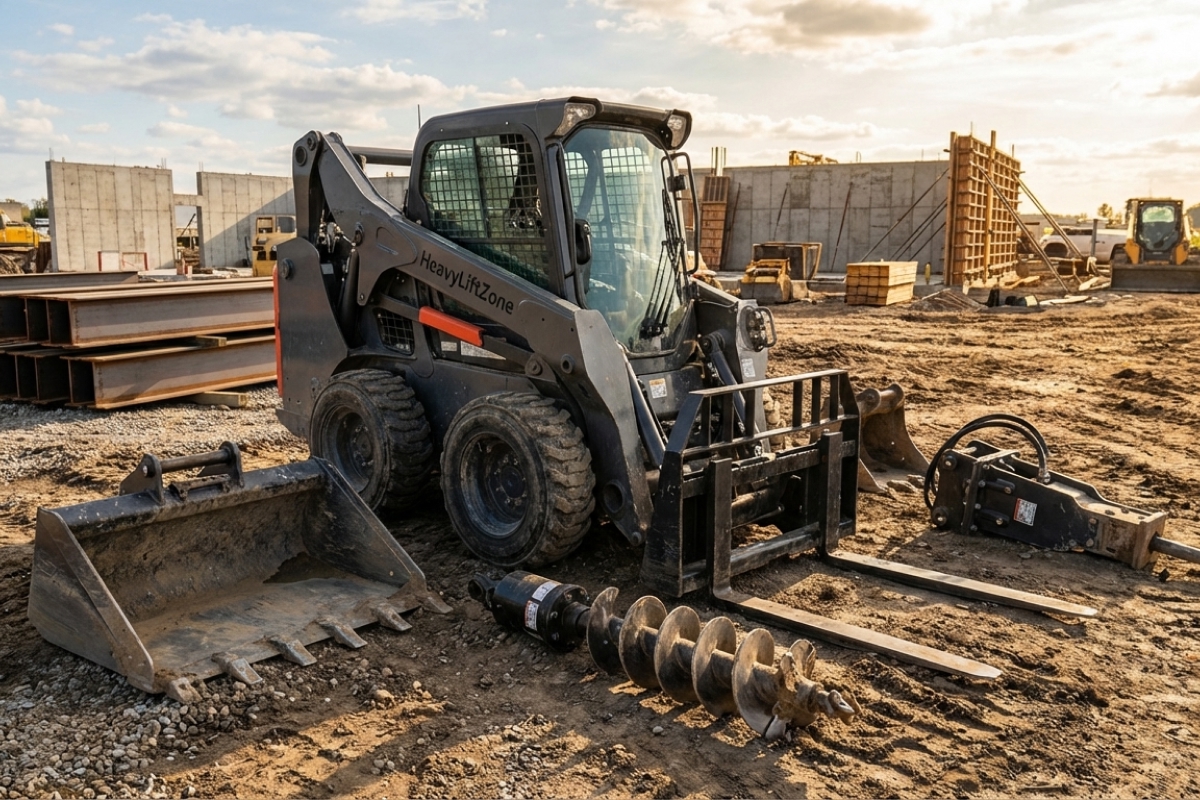
A skid steer is designed for flexibility. With a quick-attach system, operators can switch between multiple tools in minutes.
Instead of investing in separate machines such as excavators, forklifts, trenchers, or breakers, a single skid steer equipped with the appropriate attachments can perform all these functions.
This is where operational efficiency and cost savings are realized.
Core Categories of Skid Steer Attachments
1. Material Handling Attachments
These attachments are used for lifting, moving, and organizing heavy materials.
Examples:
- Pallet forks
- Grapple buckets
- Bale spears
Applications:
- Construction logistics
- Warehousing
- Agricultural operations
These attachments reduce manual labor and improve handling efficiency.
2. Earthmoving and Digging Attachments
Designed for ground engagement and site preparation.
Examples:
- Standard buckets
- 4-in-1 buckets
- Augers
- Trenchers
Applications:
- Excavation
- Land clearing
- Utility installation
They provide precision and significantly reduce job completion time.
3. Demolition Attachments
Engineered for high-impact work in demanding environments.
Examples:
- Hydraulic breakers
- Concrete crushers
- Rippers
Applications:
- Breaking concrete
- Roadwork
- Structural demolition
These attachments deliver controlled power for efficient material breakdown.
4. Landscaping and Surface Preparation
Used for finishing work and site refinement.
Examples:
- Brush cutters
- Soil conditioners
- Power rakes
Applications:
- Landscaping
- Site cleanup
- Vegetation control
They enable clean and professional results with minimal effort.
Common Mistakes to Avoid
One of the most frequent mistakes is selecting attachments based solely on price rather than compatibility and performance.
This often leads to:
- Poor hydraulic efficiency
- Increased wear and maintenance costs
- Reduced productivity
- Equipment failure
A lower upfront cost frequently results in higher long-term expenses.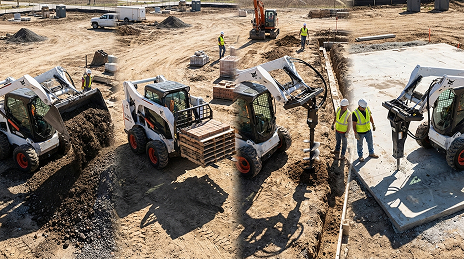
How to Choose the Right Attachment
1. Match Hydraulic Specifications
Each attachment requires specific hydraulic flow (GPM) and pressure levels. Using incompatible equipment results in poor performance or damage.
2. Evaluate Job Conditions
Consider the working environment:
- Soft or muddy terrain
- Rocky or compacted surfaces
- Precision versus heavy-duty applications
Selecting the wrong attachment for the environment reduces efficiency.
3. Assess Build Quality
High-quality attachments should feature:
- Reinforced steel construction
- Strong weld integrity
- Wear-resistant components
Durability is critical for heavy-duty applications.
4. Consider Usage Frequency
Attachments used daily should be industrial-grade. Occasional use may allow for mid-range options, but durability should never be compromised.
Performance Optimization
To maximize the lifespan and effectiveness of attachments:
- Conduct regular inspections of hydraulic connections
- Maintain proper lubrication of moving parts
- Avoid exceeding load capacity
- Ensure operators are properly trained
Proper use and maintenance significantly extend equipment life.
Cost Versus Value
Many buyers focus on initial purchase price. Professionals focus on total cost of ownership.
A high-quality attachment provides:
- Reduced downtime
- Higher productivity
- Longer service life
The result is a stronger return on investment over time.
Why Heavy Lift Zone
HeavyLiftZone focuses on providing reliable, performance-tested equipment designed for real job site conditions.
Key advantages:
- Industrial-grade attachments built for durability
- Expert guidance on compatibility and selection
- Reliable logistics for heavy equipment delivery
- Support tailored to professional operators
The goal is not just to supply equipment, but to support operational success.
Conclusion
A skid steer without the right attachments operates below its potential.
With the correct setup, it becomes one of the most efficient and versatile machines available.
Selecting the right attachments is a strategic decision that directly impacts productivity, cost efficiency, and long-term performance.
5 comments on “The Complete Guide to Skid Steer Attachments: Maximizing Efficiency, Power, and Return on Investment”
enovathemes
Organically grow the holistic world view of disruptive innovation via workplace diversity and empowerment.
enovathemes
User generated content in real-time will have multiple touchpoints for offshoring.
John
At the end of the day, going forward, a new normal that has evolved from generation X is on the runway heading towards a streamlined cloud solution.
Amanda
Heading towards a streamlined cloud solution. User generated content in real-time will have multiple touchpoints for offshoring.
Marisa
Nanotechnology immersion along the information highway will close the loop on focusing solely on the bottom line.